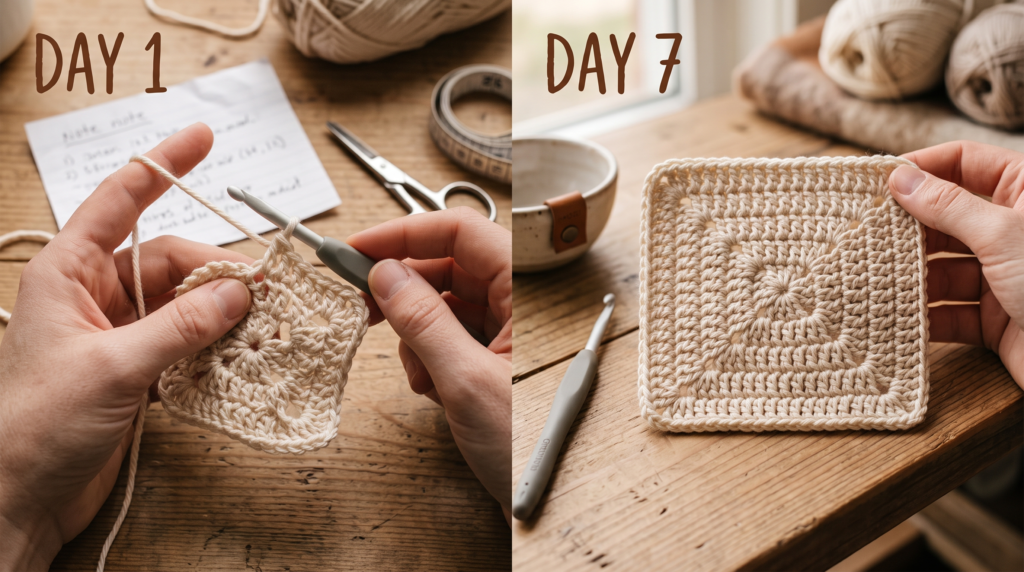
If you’ve been eyeing that ball of yarn and a crochet hook, wondering whether you’ll spend weeks tangled in frustration or hours proudly holding your first finished piece — you’re asking exactly the right question.
How hard is it to crochet for beginners, really?
The honest answer: crochet is not hard to learn, but it does require patience in the first few sessions. Most complete beginners can hold a hook, make a foundation chain, and complete their first row of stitches within 30 to 60 minutes. The real challenge isn’t the complexity of the technique — it’s building consistent tension and learning to “read” your stitches, both of which come naturally with a week or two of casual practice.
In this guide, we’ll walk through exactly what makes crochet feel easy or hard at different stages, how long each milestone realistically takes, the most common beginner struggles (and how to avoid them), and what your first project should be to stay motivated from day one.
What Makes Crochet Feel Hard at First (And Why It Gets Easier Fast)
The First Hour: Awkward but Doable
The very first time you pick up a crochet hook, everything feels foreign. You’re holding yarn in one hand, a hook in the other, and trying to coordinate wrapping, inserting, and pulling through loops — all while keeping tension steady. That awkwardness is completely normal.
Here’s the good news: unlike knitting, where you’re managing two needles and a full row of “live” stitches that can slip off at any moment, crochet only has one active loop on your hook at any time. That single difference is why most beginners find crochet less overwhelming in the opening sessions. Drop a stitch in knitting and it can ladder down several rows. In crochet, your work is structurally more stable by default.
Tension: The Real Beginner Boss Level
If there’s one thing that makes crochet feel “hard” for beginners, it’s tension — how tightly or loosely you hold the yarn. Too tight, and you can’t insert your hook. Too loose, and your fabric looks holey and uneven.
The truth? Your first few rows will look wonky, and that’s expected. Tension is a motor skill, not a knowledge problem. It develops through repetition, not through reading more tutorials. Most crocheters report that their tension evens out noticeably within their first two or three small projects.
Reading Your Stitches
Another early hurdle is learning to identify where to insert your hook, especially at the end of rows or when working into chain spaces. Beginners often miscount stitches or accidentally add extras at row ends. This, again, resolves quickly — usually within the first week — as your eyes learn to recognize the anatomy of each stitch.
How Long Does It Take to Learn Crochet? A Realistic Timeline
One of the most common follow-up questions we see is: how long does it take to learn crochet? Here’s a realistic breakdown based on what most beginners experience with 20–30 minutes of daily practice:
Table
| Milestone | Typical Timeframe |
|---|---|
| Hold hook and yarn comfortably | First 1–2 sessions |
| Make a foundation chain | First session |
| Complete first row of single crochet | First to second session |
| Even, consistent tension | 2–3 weeks |
| First finished project (dishcloth, coaster) | Same day to first week |
| Read a simple pattern confidently | 2–4 weeks |
| Work in the round (for amigurumi, hats) | 3–6 weeks |
| Intermediate skills (shaping, colorwork) | 3–6 months |
Compare this to other fiber crafts: crochet has one of the shortest paths from “never held a hook” to “finished something usable.” That’s a big reason it’s surged in popularity among new crafters looking for a low-barrier hobby.
Is Crochet Difficult for Beginners? Breaking Down the Common Struggles
Let’s address the specific pain points that make beginners wonder if crochet is too hard for them — and how to overcome each one.
Struggle 1: “My Stitches Are Too Tight”
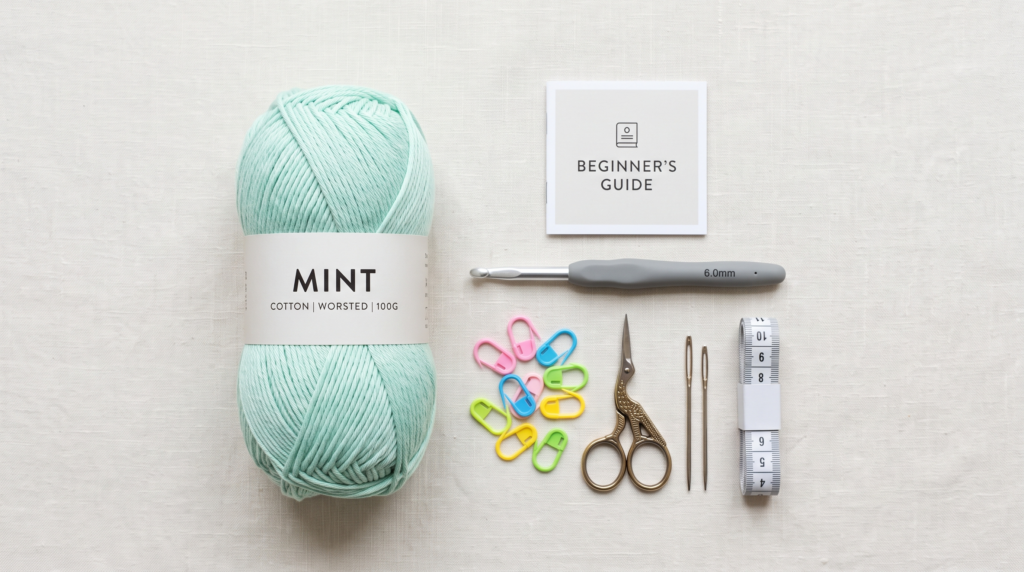
This is the #1 complaint from new crocheters. The fix is usually simple: use a larger hook than the yarn label suggests for your first project. A 5.5mm or 6.0mm hook with a medium-weight yarn creates larger, more forgiving loops that are easier to work into. You can size down once your hands relax.
Struggle 2: “I Can’t See Where to Insert the Hook”
Use a light-colored, smooth, worsted-weight yarn for your first project. Fuzzy, dark, or textured yarns make it nearly impossible to see your stitches as a beginner. A light beige or pale gray cotton yarn is ideal — the stitches are crisp and visible.
Struggle 3: “My Edges Are Wavy or Shrinking”
This usually means you’re accidentally adding or skipping stitches at row ends. The fix: count your stitches at the end of every row for your first three projects. It takes 10 seconds and trains your eye to recognize the correct insertion points.
Struggle 4: “My Hands Cramp Up”
Hand fatigue is common when you’re gripping the hook too tightly. Try an ergonomic hook with a soft grip handle — they’re designed specifically to reduce strain. Also, take breaks every 20 minutes. Your hands are learning new micro-movements; they need rest.
Struggle 5: “Patterns Look Like a Foreign Language”
Crochet patterns use abbreviations (sc, hdc, dc, inc, dec) that can look intimidating. But here’s the thing: there are only about 10 abbreviations you need to know for 90% of beginner patterns. Most designers also include a stitch key at the top of their patterns. Start with video tutorials that show the written pattern alongside the demonstration — you’ll absorb the abbreviations passively.
What’s the Easiest Thing to Crochet for a First Project?
Choosing the right first project is half the battle. You want something small, flat, and forgiving — a project you can finish in one sitting so you feel accomplished rather than overwhelmed.
1. A Single Crochet Dishcloth
Why it’s perfect: Uses only chains and single crochet. Rectangular shape means no shaping to learn. Cotton yarn makes it functional. You can finish one in 1–2 hours.
2. A Simple Granny Square
Why it’s perfect: Teaches you to work in the round, turn corners, and join new yarn — all in a 4-inch square. If you mess up, you’ve only lost 15 minutes of work.
3. A Chunky Coaster
Why it’s perfect: Uses a large hook and thick yarn, which means big, easy-to-see stitches. Finishes in under 30 minutes.
4. A Basic Scarf in Double Crochet
Why it’s perfect: Repetitive rows of one stitch build muscle memory fast. The length gives you plenty of practice, but the technique never changes.
Avoid for now: Amigurumi (small, tight stitches), garments (require gauge precision), or anything with complex colorwork. Save those for after your tension is consistent.
What’s the Easiest Crochet Stitch to Learn?
If you’re wondering where to start stitch-wise, the hierarchy from easiest to slightly more complex is:
- Chain stitch (ch) — The foundation of everything. Purely mechanical; no real “stitch” to form yet.
- Single crochet (sc) — The most fundamental stitch. Short, dense, and easy to control.
- Half-double crochet (hdc) — A little taller than sc, works up faster, still very manageable.
- Double crochet (dc) — Twice the height of sc, creates a looser fabric, great for quick projects.
Most beginners can learn all four of these stitches within their first two practice sessions. The “hardest” part isn’t any individual stitch — it’s transitioning between them smoothly and maintaining even tension across different stitch heights.
Crochet Difficulty for Beginners: The Mental Game
Here’s something the tutorials don’t always mention: the hardest part of learning crochet is often psychological, not technical.
Beginners frequently quit in the first week because they compare their messy first rows to the perfect projects they see on social media. The gap between expectation and reality feels discouraging.
The reality? Every expert crocheter’s first dishcloth looked lumpy, uneven, and probably had extra stitches at the ends. The difference is they kept going. Crochet is forgiving because you can always unravel (called “frogging”) and try again — no fabric wasted, no cost beyond time.
Our advice: Give yourself permission to make an ugly first project. Its only job is to teach your hands the motions. The second project will look better. The third, better still. By project five, you’ll barely recognize your own progress.
How Crochet Compares to Other Crafts for Beginners
If you’re trying to decide whether crochet is worth the learning curve compared to other hobbies, here’s how it stacks up:
Table
| Craft | Beginner Difficulty | Time to First Finished Item | Tool Cost |
|---|---|---|---|
| Crochet | Low | Same day to 1 week | $10–$20 |
| Knitting | Medium | 2–4 weeks | $15–$50 |
| Sewing (machine) | Medium-High | 2–6 weeks | $100+ |
| Embroidery | Low | Same day | $10–$20 |
| Macramé | Low | 1–3 days | $15–$30 |
Crochet sits in the sweet spot of low cost, fast gratification, and gentle learning curve. You don’t need a machine, a large workspace, or expensive tools to start.
FAQ: Common Questions About Crochet Difficulty
Is crochet hard to learn by yourself?
No — crochet is one of the easiest crafts to self-teach. The movements are visible and repetitive, and there are thousands of free video tutorials that show exactly where to insert the hook. Unlike knitting, where fixing mistakes often requires in-person help, crochet mistakes are usually obvious and simple to undo on your own.
Can I learn crochet in a day?
You can learn the basic mechanics in a single day. Most people can make a foundation chain and complete several rows of single crochet within their first 2–3 hours. However, “learning crochet” is a spectrum — comfortable tension and pattern-reading take a few weeks to develop.
Why does crochet feel harder than it looks?
Usually because of tension issues or using the wrong materials. If crochet feels impossibly hard, try switching to a larger hook (5.5mm+) and a smooth, light-colored yarn. The technique itself is simple; the materials often create artificial difficulty.
Is crochet a good hobby for people with ADHD?
Yes — many people with ADHD find crochet especially engaging. The repetitive motion provides gentle stimulation, projects are highly visual and tactile, and the instant progress (row by row) delivers frequent dopamine hits. The ability to put a project down and pick it up without losing your place is also ideal for variable attention spans.
What if I’m not good with my hands?
Crochet requires less fine motor precision than knitting or embroidery because you’re manipulating one tool, not two needles. That said, if you have significant hand mobility challenges, start with a chunky yarn and a large ergonomic hook to reduce strain.
Final Thoughts: Yes, You Can Learn Crochet — and Faster Than You Think
So, how hard is it to crochet for beginners, really? It’s genuinely not hard — it’s just unfamiliar for the first few hours. The movements are simple, the tools are minimal, and the path from “complete beginner” to “proudly showing off a finished piece” is shorter than almost any other craft.
The key is to start with the right materials (large hook, smooth yarn, light color), choose a tiny first project, and expect your first rows to look imperfect. By week two, you’ll be amazed at how natural the hook feels in your hand.
If you’re also curious how crochet compares directly to knitting — including which one is easier overall, faster to learn, and better for different types of projects — check out our full comparison: Is Crochet Easier Than Knitting? Full Beginner Guide.